%20--%3e%3cdefs%3e%3cstyle%3e%20.st0%20{%20fill:%20%23989aa5;%20}%20.st1%20{%20fill:%20%230051bb;%20}%20%3c/style%3e%3c/defs%3e%3cg%3e%3cpolygon%20class='st0'%20points='69.2602%2069.4737%20104.6531%2069.4737%20104.6531%2060.4924%2078.1083%2060.4924%2078.1083%2051.6441%20100.2289%2051.6441%20100.2289%2042.796%2078.1083%2042.796%2078.1083%2033.9477%20104.6531%2033.9477%20104.6531%2025.0574%2069.2602%2025.0574%2069.2602%2069.4737'/%3e%3cpolygon%20class='st0'%20points='160.1877%2054.5947%20138.0841%2025.1016%20129.219%2025.0574%20129.219%2069.3406%20138.0841%2069.3406%20138.0841%2039.8726%20160.1877%2069.3406%20169.0361%2069.3406%20169.0361%2025.0574%20160.1877%2025.0574%20160.1877%2054.5947'/%3e%3crect%20class='st0'%20x='193.602'%20y='25.0574'%20width='8.8483'%20height='44.2832'/%3e%3cpath%20class='st0'%20d='M24.8244,42.8324l-3.541,8.8483h15.2613c-1.8651,5.6716-7.2032,9.7815-13.491,9.7815-7.833,0-14.2056-6.3726-14.2056-14.2058s6.3726-14.2056,14.2056-14.2056c1.8661,0,3.6346.3885,5.2643,1.0519l3.3011-8.2495c-2.6485-1.0617-5.5372-1.6505-8.5654-1.6505C10.3215,24.2026,0,34.5241,0,47.2564s10.3215,23.0541,23.0537,23.0541,23.0541-10.3217,23.0541-23.0541c0-1.5142-.1558-2.9912-.4345-4.424h-20.849Z'/%3e%3cpath%20class='st0'%20d='M416.5159,25.0996l-19.9084-.0422v44.2834h8.8479v-13.2657l11.0605-.0068c8.5164,0,15.4841-6.968,15.4841-15.4845h0c0-8.5164-6.9676-15.4843-15.4841-15.4843ZM423.1841,40.5574c0,3.653-2.9888,6.6415-6.6417,6.6415h0l-11.0869.0186v-13.3017h11.0869c3.653,0,6.6417,2.9886,6.6417,6.6415h0Z'/%3e%3cpath%20class='st0'%20d='M372.0412,40.5838h0c0-8.5164-6.968-15.4843-15.4841-15.4843l-19.9084-.0422v44.2834h8.8479v-13.2657l11.0605-.0068c.2927,0,.5782-.028.8674-.0442l5.3337,13.3261h9.5257l-6.537-16.3462c3.8061-2.828,6.2942-7.3417,6.2942-12.4201ZM363.2253,40.5574c0,3.653-2.9892,6.6415-6.6417,6.6415l-11.0869.0186v-13.3017h11.0869c3.6526,0,6.6417,2.9886,6.6417,6.6415h0Z'/%3e%3cpath%20class='st0'%20d='M290.3093,3.7965l-4.4639,7.7364c9.8109,3.9189,17.6019,11.8447,21.342,21.7439h9.345c-3.9549-13.2573-13.6662-24.0553-26.2231-29.4803Z'/%3e%3c/g%3e%3cg%3e%3cpath%20class='st1'%20d='M253.0626,68.3533l10.0145-17.3576h-10.2284l-5.8264,10.0983c1.6066,2.7405,3.6519,5.1914,6.0403,7.2593Z'/%3e%3cpath%20class='st1'%20d='M318.2553,42.1363h-32.413l-13.9411-24.1626-13.941,24.1626h10.2282l3.7128-6.4351,18.8386,32.6521c2.3883-2.0679,4.4338-4.5188,6.0403-7.2595l-5.8262-10.0981h18.3924c-2.1998,18.7116-18.152,33.2769-37.445,33.2769-20.7916,0-37.7069-16.9149-37.7069-37.7066s16.9153-37.7066,37.7069-37.7066c1.7163,0,3.4054.1176,5.0615.3408l4.711-8.1652c-3.1525-.6759-6.4211-1.035-9.7724-1.035-25.6767,0-46.5664,20.8893-46.5664,46.566s20.8897,46.566,46.5664,46.566,46.566-20.8893,46.566-46.566c0-1.4941-.0736-2.9712-.212-4.4297Z'/%3e%3c/g%3e%3c/svg%3e)
Location certificate: what you need, and when
Your notary or lender requires it before signing. We prepare the official document, signed and sealed by a land surveyor, prioritizing files with an approaching signing date.
Files prioritized around your notary signing date
- Timeline
- Confirmed in writing as soon as you request it
- Price
- Firm price, based on lot area and complexity
- Validity
- As long as the property hasn't changed
- Signature
- Land surveyor, member of the OAGQ
You need one if…
The location certificate describes the actual state of your property: buildings, boundaries, easements and encroachments. It carries the professional liability of the land surveyor who signs it.
You're selling
You're refinancing
You've built something
Four steps, one point of contact
1. Your request
Send us the address, lot number and planned signing date with the notary. We confirm an achievable timeline.
2. Title research
We obtain the title of ownership, the cadastral plan and the official documents tied to your lot.
3. On-site survey
Our team surveys the buildings, boundaries, visible easements and any encroachments.
4. Plan and report
The land surveyor prepares the plan and report, signs and seals them, then we send you the PDF and paper copy.
What we need from you
- 01The full address and lot number of the property.
- 02A copy of your title of ownership (notarial deed), if available.
- 03The existing location certificate, even if it's old.
- 04Your notary's contact information and the target signing date.
- 05Any permits or plans for work done since the last certificate.
Price and turnaround confirmed in writing
Get my certificateCost, timeline, validity: the answers
The eight questions homeowners, buyers and notaries ask us most often, with complete answers.
What is a location certificate?
It is a report and plan prepared, signed and sealed by a land surveyor, describing the current state of a property: lot boundaries, buildings and structures, easements, encroachments and compliance with zoning bylaws. It is the document required by the notary and by the mortgage lender for a real estate transaction in Québec.
How much does a location certificate cost?
There is no fixed rate. The price depends on the lot's area, the number of buildings, the complexity of the title and cadastre, whether an earlier certificate exists, and the requested timeline. We provide a firm price in writing before starting, with no hidden fees.
How long does it take to get one?
The timeline depends on the time of year, title research at the land registry, and access to the property. We confirm a firm date as soon as we receive your request and prioritize files with a notarized signing date already set.
How long is a location certificate valid?
No law sets an expiry date. It remains valid as long as it accurately reflects the property and the cadastre. As soon as a structure is added or modified, it becomes outdated. In practice, many lenders and notaries require a document less than ten years old.
How do you get a location certificate?
You must order it from a land surveyor. Provide the address, lot number, your title of ownership and the target signing date. The land surveyor conducts the title search, the on-site survey, then prepares the signed and sealed plan and report.
How do you get a copy of your location certificate?
The original copy is usually found in your notarial file or with the land surveyor who prepared it, who is required to keep their minutes. If you don't know who produced it, your notary or lender can often trace it. Otherwise, a new certificate must be ordered.
Who can sign a location certificate in Québec?
Only a land surveyor who is a member of the Ordre des arpenteurs-géomètres du Québec can prepare, sign and seal a location certificate. They bear professional liability for the content of the document.
How do you read a location certificate?
The plan shows the lot boundaries, the position of buildings and their distances to property lines. The written report accompanies the plan and flags irregularities: encroachment, zoning non-compliance, easements, insufficient setbacks. These are the items the notary reviews first.
To learn more: what determines the price, when a new certificate is required and our property-limit staking service.
Where we prepare location certificates
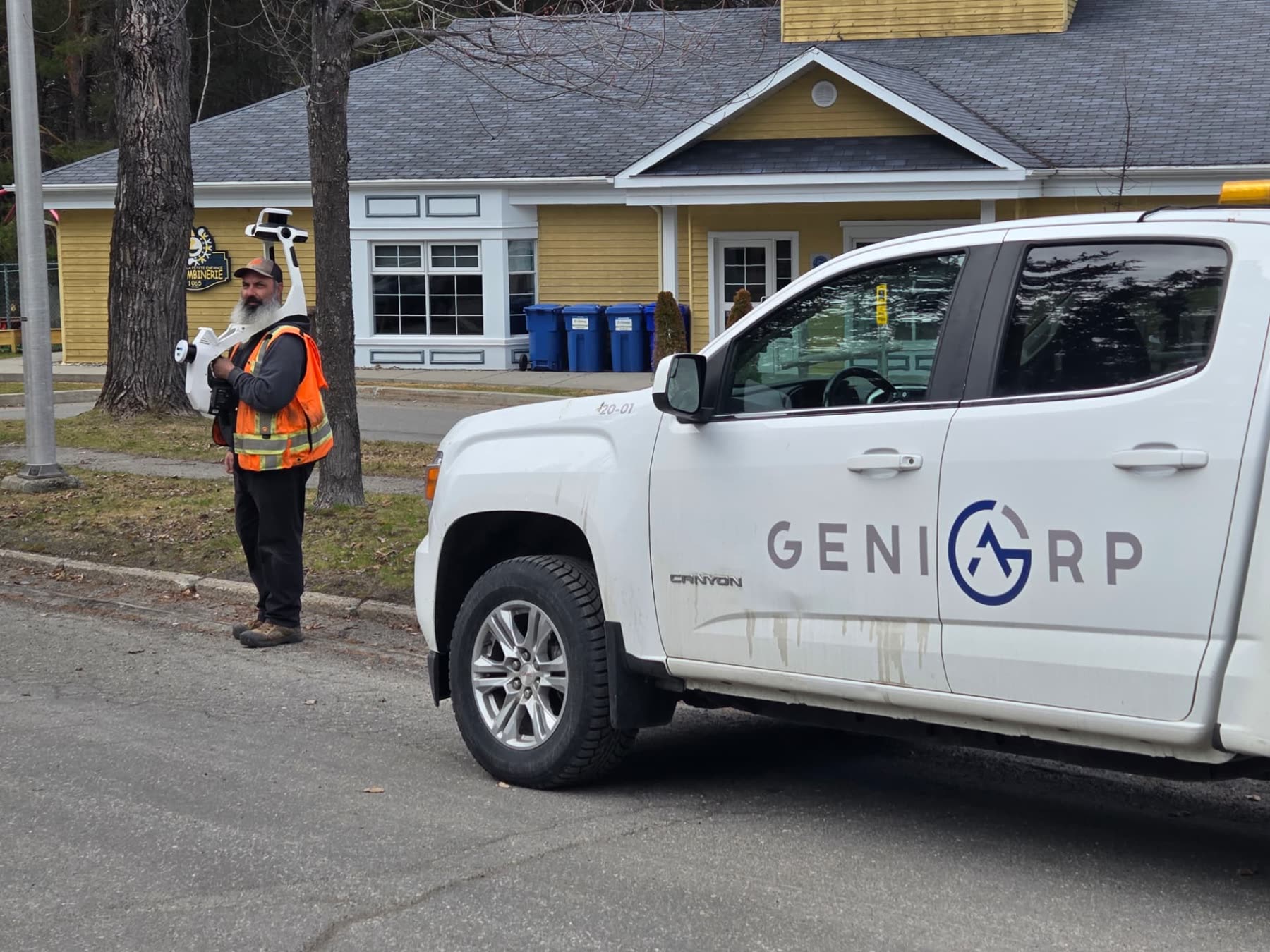
Our legal surveying teams mobilize across Québec every day, from our head office in Québec City.
What our clients say
“Exceptional service at Geniarp! I am impressed by the speed and simplicity of the process. Everything was handled efficiently, which allowed me to get exactly what I needed without hassle. A smooth, professional and pleasant experience. Thank you for your excellent work, I will not hesitate to do business with you again!”
“Exceptional and professional service.”
Get your location certificate prepared
Provide the property address and the target signing date. We confirm the timeline and price in writing.
No commitment · Over 35 employees · Across Québec